VTeam Management
- Author
- Leonardo Pinero-Perez
- Written
- 2018 · Report, University of Texas at Arlington
- Original
- Full report · 120 pages
- Contents
- Nomenclature · Chapter I · II · III · IV · V · VI · VII · VIII · IX · X · XI · Appendix · References
- Ref
- MAE 4351-2018
Converted from the original PDF on with Claude Opus 5.5. The wording is unchanged, except: two classmates’ names are replaced by their roles, Figure 54 (an attendance sheet) is omitted, and my name is spelled without accents. Equations, figures and numbering follow the original. Conversion not yet checked against the PDF.
ATeam Structure
The team is split into two main groups: one designs the hypersonic vehicle, the other designs the launch system. Both teams are headed by the author, who is the chief engineer for the hypersonic vehicle. Both chiefs are involved in their respective vehicle’s synthesis and are to determine costs and the business case for a mission. The structure and domains of work for the rest of the team are shown below, which is divided by discipline.
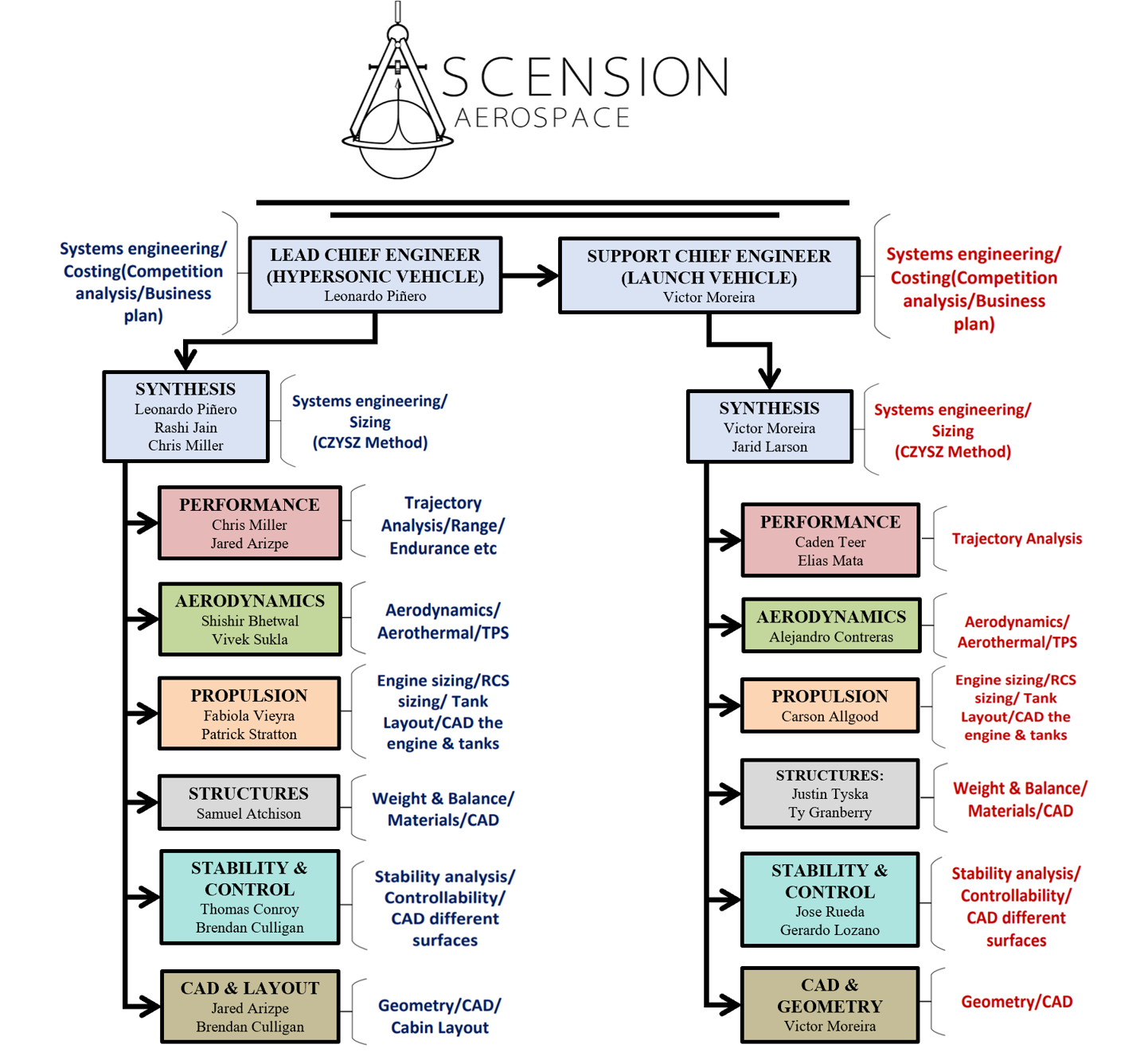
The author’s main work is to direct and bring together the many aerospace disciplines in the class team into one cohesive design. This includes writing the team report, one synthesized script, and developing a sizing methodology to provide key design parameters that meet the mission. The team structure is shown below, outlining all disciplines and their main task in developing a conceptual design for this vehicle.
The author must also develop a business case for the mission to meet military and market needs. This position is unique in that it must be familiar with the roles of all disciplines to build the bigger picture of the purpose of design. The methodology and early decision-making in conceptual design is usually what determines the success of a program. For this reason, the role of developing the multi-disciplinary analysis and methodology bears a large responsibility.
Additionally, the role of chief engineer contains a significant human element. It is the responsibility of the author to make sure team deliverables are completed on schedule and every group member is contributing to the team effort. The chief is also the arbiter of disagreements over deliverables and domains of work. This requires a balance between what is realistic to complete in the summer semester timeframe and what must be done to produce an exceptional project [33].
There are many individuals who are in multiple disciplines according to preferences and needs, which facilitates inter-disciplinary know-how and interaction. For example, many stability derivatives are from geometric values, so a CAD engineer is placed in the stability and control discipline.
BNear-term Timeline
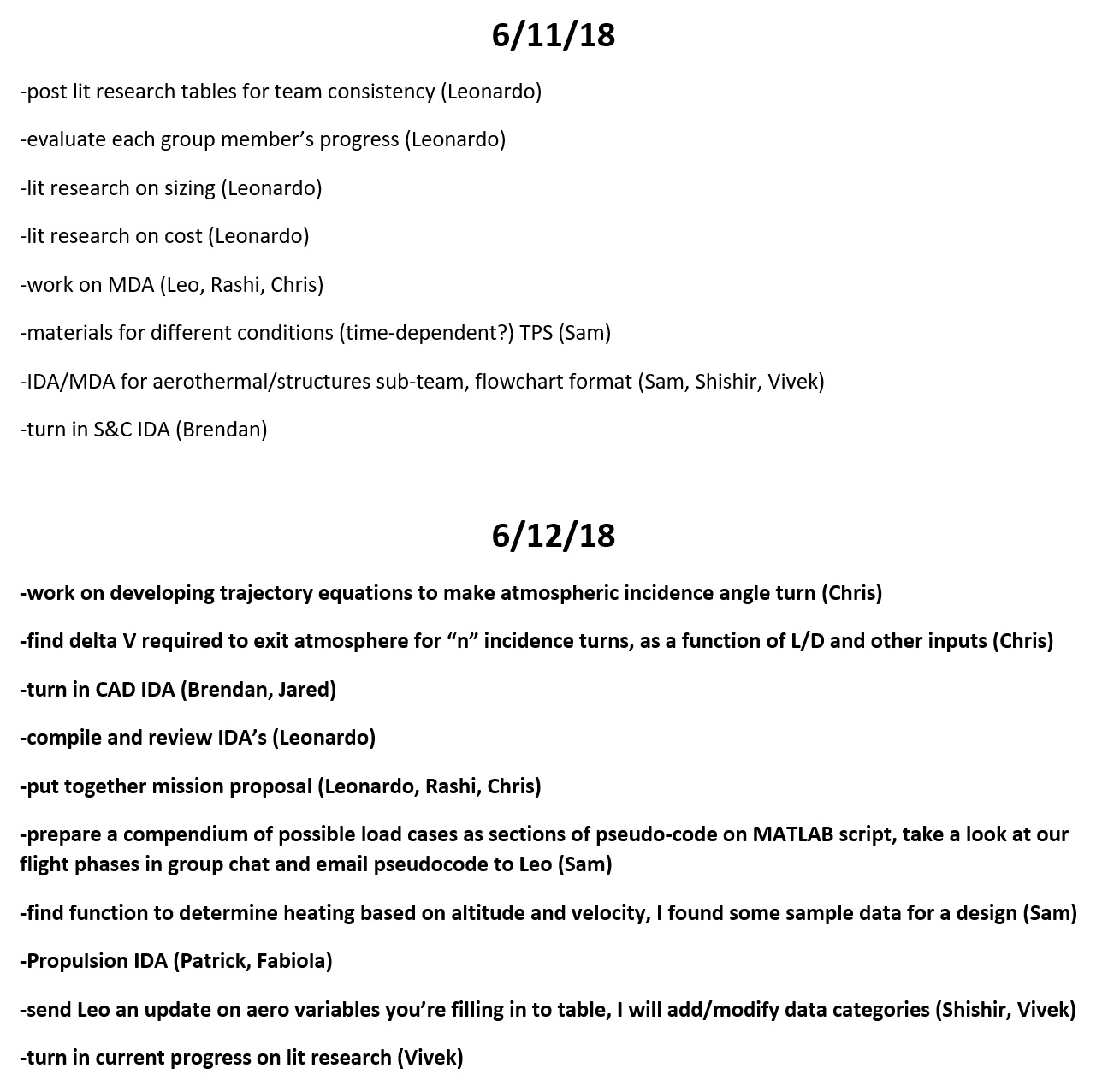
For day-to-day tasks before reports, the chief lays out what each discipline must complete to keep the team on schedule for deliverables expected for the next report. This timeline used to be organized for each individual, but was updated to show day-by-day progress, with individuals responsible for the task marked by each task. Incomplete tasks are bolded, and un-bolded when complete. Below is a sample of this timeline, taken at the end of June 11th, 2018:
CSemester Timeline
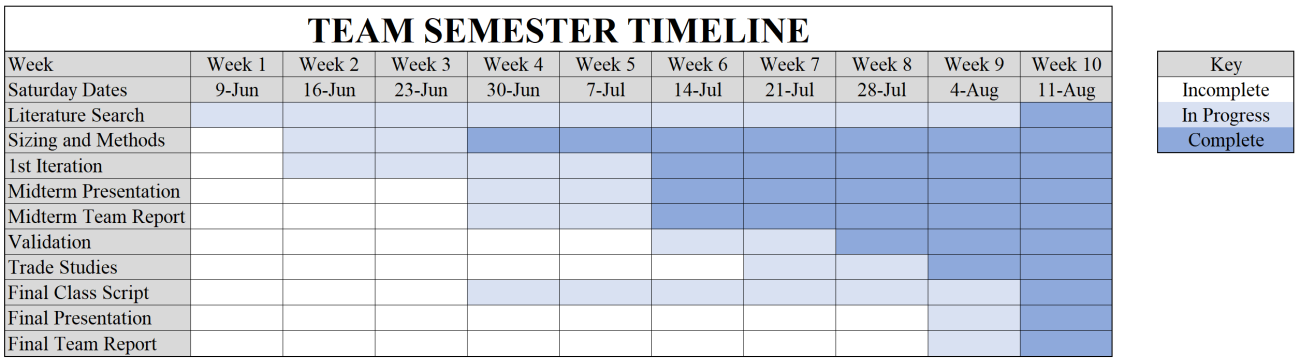
The semester timeline follows the main deliverables for key points such as the midterm presentation and team report (being the chief’s responsibility to put together, much of the team report is developed in his individual reports). The timeline shown below is a tentative one for the summer semester following the class syllabus and will be continuously updated according to team performance. By midterm, the timeline has been followed without delays, which is a testament to lessons learned in MAE 4350. The timeline is shown below:
DTeam Member Performance
So far, every group member has been able to keep to their deadlines. Any delays are discussed prior to the deadline and readjusted in the near-term timeline within reason so that the team is not unexpectedly held back.
An emphasis on creating MATLAB scripts has been made in week 4, as every discipline is now expected to write out their methods in code. By doing this, the “rubber meets the road”, and disciplines are required to declare variables (with needed inputs using dummy values at the introduction) and see how they connect across equations. Additionally, scripts have a top-down flow that is paramount to streamlining methods and IDA’s. This is also a concrete deliverable that will be extremely useful in gaging discipline progress, as well as developing a cohesive synthesis script in preparation for the midterm presentation.
The author has noticed that there is a decrease in attendance which is negatively affecting team performance. After the midterm, the lead chief will begin to fill out an attendance report for each meeting to track performance on this avenue. It is deemed a necessary counter-measure to bring productivity back up.
[Figure 54, the team attendance sheet, is omitted from the web version.]
The author has found that Aerodynamics is not providing their deliverables this late in the semester. Stability and Control requires inputs from Aerodynamics ([the aerodynamics engineer]) concerning the lift-curve slopes for the craft. This discipline has not provided the required deliverables for Stability and Control as needed. If he has provided deliverables, it was not in a timely manner nor of sufficient quality (especially considering this is a primary deliverable). Consequentially, this sort of performance is exemplified by the attendance sheet. Fortunately, the Stability and Control team is able to conduct analysis with substitute data, but by lacking data from other disciplines, they are not as attached to the multi-disciplinary analysis as they would like to be. This discipline is among the best-performing in the hypersonic team, as all their deliverables have been met on time or ahead of schedule, so it is not from a lack of analysis on their part. This statement is also exemplified by the attendance sheet.
The performance team has not been able to provide angle-of-attack data vs. Mach to stability and control as well; however, this comes from a gridlock of not having lift-curve slope data. Performance has been in communication with Stability and Control and has provided whatever he can.
Fortunately, the aerodynamics discipline was able to provide deliverables on time before the final presentation, but it was not in time for stability and control to include the new aerodynamic parameters in their methodology for the presentation. The performance engineer was able to conduct his analysis.
Spotted an error, or want to reply? Email me: leonardo.pinero42 [at] gmail [dot] com