IXCost Analysis
- Author
- Leonardo Pinero-Perez
- Written
- 2018 · Report, University of Texas at Arlington
- Original
- Full report · 120 pages
- Contents
- Nomenclature · Chapter I · II · III · IV · V · VI · VII · VIII · IX · X · XI · Appendix · References
- Ref
- MAE 4351-2018
Converted from the original PDF on with Claude Opus 5.5. The wording is unchanged, except: two classmates’ names are replaced by their roles, Figure 54 (an attendance sheet) is omitted, and my name is spelled without accents. Equations, figures and numbering follow the original. Conversion not yet checked against the PDF.
The procedure for identifying costs is outlined in the literature review, and the steps for actual analysis and results are explained section by section in this chapter. These methods were developed by NASA in 2015 and is relatively straightforward. The simplicity of this cost analysis does not negate its importance, as the chief’s responsibility to make a project economically viable is complemented with the disciplinary deliverable of producing a physically realizable conceptual design.
AUnderstanding the Project
Understanding the project can be described by the elements described in the cost analysis section of the literature review. The author attempts to answer these questions to begin the cost estimate analysis below.
Data:
- Type of data needed: historical trends, cost estimate methodologies, professor guidance, market news
- Data availability: most of NASA data is public domain, recently unclassified 176 documents
- Outside Organization Co-operation: NASA documents are freely available, faculty is helpful and disposed to consult with team, SpaceX data is mostly proprietary and limited
- Non-disclosure agreements: none
Resources:
- People required: mainly the lead chief, though the support chief should analyze respective sub-team
- People available: both chiefs
- Budget required: 3 – 5 days (estimated in days to account for lack of a budget in an academic setting)
- Budget Available: 11 weeks
Expectations:
- Expected Outcome: inform the business case for conceptual design, allocate proper funds for further design work and program support
- Customer Expectation: a proper assessment of cost versus expected revenue from market analysis
- Team Expectation: a framework and constraint for economic feasibility with the same stringency as physical and technical feasibility
- Agency-wide Expectations: a successful program from the above two expectations (where market demands meet feasibility for a viable business model)
Schedule:
- Time to collect required data: 11 weeks
- Resources to meet time constraint: disciplinary input on costing, such as engine specifications, R & D required for TPS, Stability & Control system, ICI required, etc.
BWork Breakdown Structure
Below is the preliminary work break down structure (WBS) for engineering requirements based on the team activities experienced to date and anticipated activities. This is a Level 3 WBS, where at this step the budget is undefined. The WBS will be expanded upwardly to a Level 4 to include the entire project as a whole after the engineering work. This will include operations, launch, construction, and miscellaneous expenses.
The difference between the engineering work and the other activities is that the engineering will represent the initial program cost, and the other activities are ongoing expenses as a function of usage, market size, and time in use. These will cut into the yearly profit or budget, while engineering is the large upfront cost. Additionally, the activities involved with the engineering work category are being conducted in this project at the conceptual level. There is a direct relationship between the technical challenges, solutions, and hardware specifications and the upfront cost of this program.
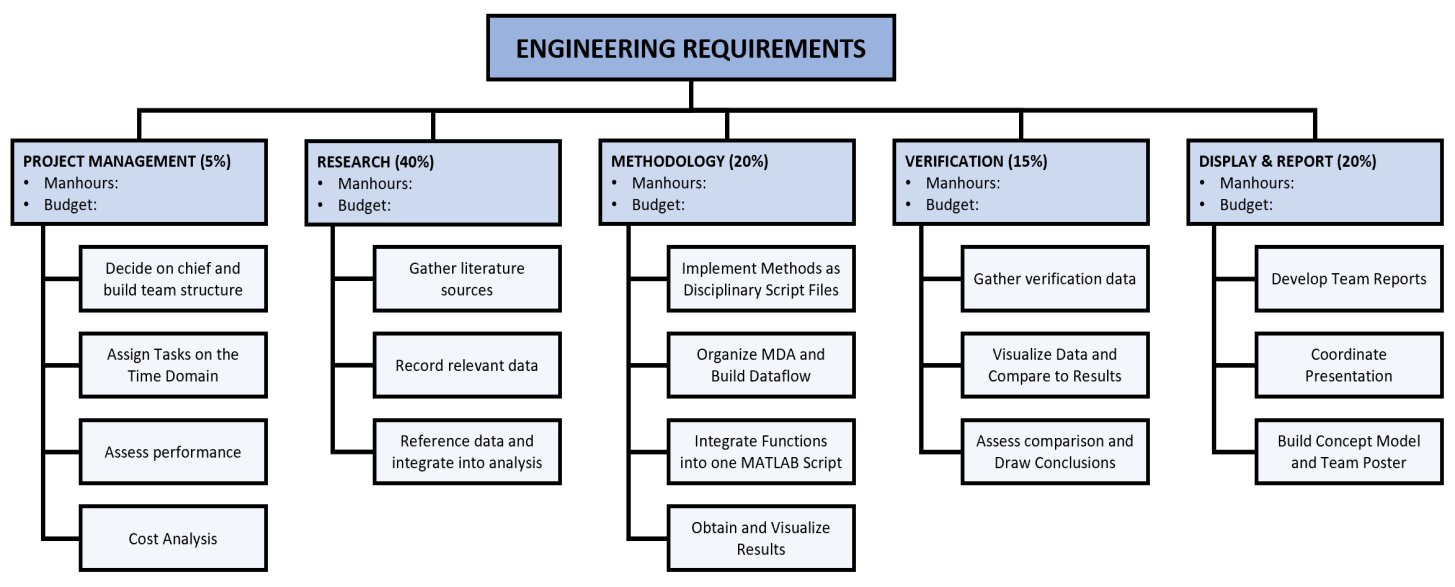
Next to each Level 2 WBS element, there is an estimated percentage of productive time invested. This is subject to change but should provide a guideline for future budget and manhour estimations.
CDefine Project Technical Description
This section will define the aspects of this project which will be analyzed. The starting costs are the engineering costs to develop a craft in the following disciplines:
- Adapt two SpaceX launch platforms
- Design three mission layouts of the same concept upper stage design
- Interior systems and equipment integration
- Switchblade wing system
- Upper Stage Engine development
- Stability and Control systems
- Hypersonic Wind-tunnel Testing
By adapting an existing launch system, the costs will be drastically reduced. By integrating with existing vehicles and programs, a project manager can avoid falling into the problem of piecemeal decision making and keep his or her agency/organization within a reasonable budget [37].
DDevelop Ground Rules
One of the expected customer deliverables is a fully developed engine, which certainly adds to costs, as is the case with conventional aircraft. Most organizations elect to use off-the-shelf propulsion systems given its complexity. However, a fully designed propulsion system at the conceptual level will provide insight into what an ideal propulsion system would look like, where such an activity will aid in engine selection should the program require reductions in development expenditure or meeting schedule in later stages of design.
EDevelopment Costs
The engineering development costs of a program can be estimated by the dry weight of the spacecraft. This is from the combination of the various systems and subsystems associated with a craft proportionate to its scale. This is one of the reasons to choose the smallest planform area possible for a spaceplane. The author has elected to only add the new dry weight to avoid double counting the cost of identical systems across different variants.
The costs are first approximated in engineering man-years, which cost the program approximately 330,000 USD per man-year (2018 dollars) [38], assumed to be covering engineering salary and its associated overhead. The minimum number of man-years required (at 30% of historical business-as-usual) for developing dry weight minus engine development is given by the trend line equation [38]:
The associated dry weight is taken from reference [1].
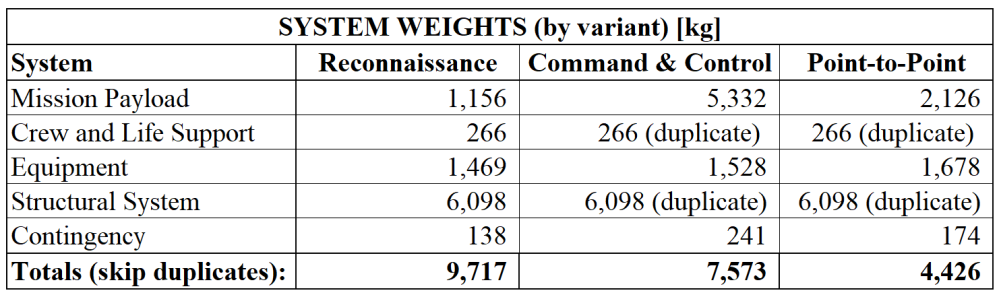
The development costs minus the engine are then determined by these weights, where each man-year costs 330,000 USD in 2018.
The development costs for a single engine designed for orbital maneuvering and re-use capability are approximated with a similar historical engine, the LR-91 [17]. For a program of 5 years at the flight rate given in the business case, the amortization of the development costs are approximately 8,000 USD per flight.
Spotted an error, or want to reply? Email me: leonardo.pinero42 [at] gmail [dot] com